Published works
Two monographs on electroencephalography and brain reactivity.
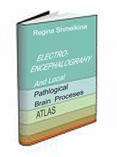
Electroencephalography and Local Pathological Brain Processes. Atlas.
View on AmazonThis book is dedicated to my father and teacher David Shmelkin (1898-1978), a professor of neurology and a pioneer of clinical EEG in the former Soviet Union.
Atlas contents
- Preface
- Chapter I. INTRODUCTION
- a. Recording techniques and methods of EEG
- b. Physiological bases of EEG
- c. Artifacts
- Chapter II. CHARACTERISTICS OF THE NORMAL EEG
- a. Normal findings
- b. Features of the basic EEG rhythms
- c. Electrographic signs of an abnormal EEG
- d. General characteristic features of the material
- Chapter III. EEG FINDINGS IN BRAIN TUMORS
- a. Focal brain lesions
- 1) Extracerebral (superficial) tumors
- 2) Intracerebral tumors
- 3) Cysts
- 4) Subcortex tumors
- 5) Tumors of the third ventricle and thalamus
- 6) Tumors of the lateral ventricles
- 7) Corpus callosum tumors
- 8) Basal tumors
- 9) Tumors of the chiasma region
- 10) Tumors of the posterior fossa (subtentorial tumors).
- Chapter IV. HEMATOMAS
- Chapter V. ABSCESSES OF THE BRAIN
- Chapter VI. DIAGNOSTIC DIFFICULTIES IN EEG INTERPRETATION
- Chapter VII. EPILEPSY AND TUMORS
- Chapter VIII. CONCLUSION
- Appendix A. Descriptions of EEGs (Figures 1-90).
- BIBLIOGRAPHICAL DATA
- INDEX
Some Findings of Brain Reactivity According to EEG Data under Influence of Stimuli in Connection with Age.
Summary
- Our research has demonstrated that in response to eye opening, all individuals have adequate level of suppression of alpha-rhythm. In group I (children) and in the group III (the elderly) there appeared to be a lower level of alpha-suppression. More markedly, alpha-attenuation was expressed in group II (adults of 18-35 years old). The failure of alpha-alteration is probably associated with the fact that mechanism of alpha blocking desynchronizing system has not matured functionally and morphologically in children, and in the elderly, it is weakened.
- We observed the reaction of alpha-rhythm in response to various inferential stimuli (visual, auditory, tactile, and smell). In the majority of cases, we revealed the suppression of alpha-rhythm. It was most pronounced in response to visual stimuli.
- The imaging of various inferential stimuli in wakefulness by healthy people, when people experience distinct feelings, causes alpha-rhythm suppression more marked in the left hemisphere. It is more pronounced in response to visual stimuli than to other modalities.
- The studies have shown that hyperventilation with combination of eye opening causes the failure of attenuation of alpha-rhythm in the same way as alpha-index. So, alpha-amplitude in all age groups was more pronounced, but stronger in children. We suppose that it may be associated with greater sensitivity of children to hyperventilation.
- There is some more parallelism between alpha-suppression in response to eye opening and alpha-suppression to visual imaging: if the reactivity to eye opening is bad, the reactivity to visual imaging is also bad, and vice versa.
- After hyperventilation during visual imaging, the significant worsening of alpha-reactivity appears in 81.2 % of the cases.
- In the first seconds after eye closure, approximately in 20% of healthy people (in 52 % of the elderly) we noticed the decreasing of alpha-rhythm "exhausting," that is further fading by amplitude and index (the so-called "exhausting" of alpha). It could be explained as a result of failure of alpha-generating mechanisms.
- After influence of hyperventilation, the "exhausting" of alpha-rhythm after eye closure is significantly worsened (it remains only in 13.3 % of cases in the elderly), or disappears at all in healthy people.
- After hyperventilation, paroxysmal activity is expressed less in athletes.
- In the majority of neurotic patients, the "exhausting" of alpha is noticed after hyperventilation and eye closure.
- The obtained data can be of significance for the determination of the criteria of normal brain activity in EEG.